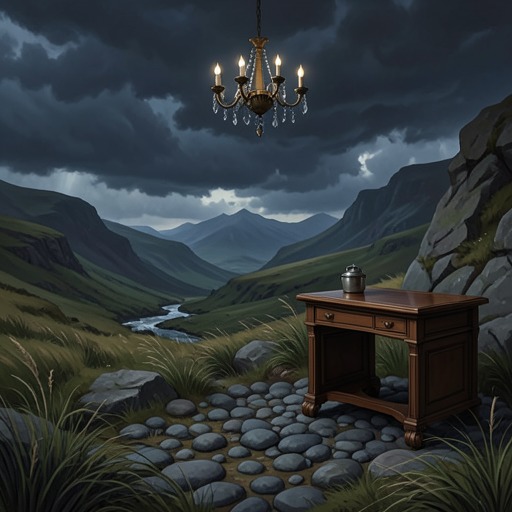
My love for Heathcliff resembles the eternal rocks beneath
Wuthering HeightsMy love for Heathcliff resembles the eternal rocks beneath is Catherine Earnshaw's most profound declaration of her bond with Heathcliff, articulated during her confession to Ellen Dean about her decision to marry Edgar Linton. The phrase contrasts her enduring, necessary love for Heathcliff with the transient, seasonal love she feels for Edgar, establishing the novel's central emotional and philosophical conflict. It becomes the touchstone for understanding Catherine's identity, her tragic choice, and the haunting that defines Heathcliff's life and death.
The Confession and Its Context
Catherine utters this declaration in a moment of intense self-revelation to Ellen Dean, explaining why she has agreed to marry Edgar Linton. She admits that her motives for the marriage are not purely romantic: "The others were the satisfaction of my whims: and for Edgar's sake, too, to satisfy him. This is for the sake of one who comprehends in his person my feelings to Edgar and myself." She frames her decision as a practical means to aid Heathcliff, whom she believes she can "place out of my brother's power" by marrying into the wealth of Thrushcross Grange. The confession reveals her conviction that her existence is not contained within herself but extends into Heathcliff: "What were the use of my creation, if I were entirely contained here?" She describes her great miseries as being Heathcliff's miseries, which she has "watched and felt each from the beginning," and declares that her "great thought in living is himself."
The Contrast with Her Love for Edgar
Catherine's metaphor draws a sharp distinction between two kinds of love. Her love for Edgar Linton, she says, "is like the foliage in the woods: time will change it, I'm well aware, as winter changes the trees." This image of seasonal decay positions her feelings for Edgar as mutable, subject to the passage of time and the natural cycle of growth and loss. In contrast, her love for Heathcliff "resembles the eternal rocks beneath: a source of little visible delight, but necessary." The rocks are unchanging, foundational, and essential—not ornamental but structural. She elaborates with the startling claim, "Nelly, I am Heathcliff! He's always, always in my mind: not as a pleasure, any more than I am always a pleasure to myself, but as my own being." The declaration collapses the boundary between self and other, presenting Heathcliff not as a separate beloved but as an extension of her own identity. When Ellen Dean reacts with impatience, calling her a "wicked, unprincipled girl," Catherine's insistence on the impracticability of separation—"So don't talk of our separation again: it is impracticable"—only deepens the sense of an inescapable bond.
The Bond's Consequences in Heathcliff's Suffering
Catherine's metaphor of the eternal rocks finds its dark echo in Heathcliff's grief after her death. When Ellen Dean tells him that Catherine "lies with a sweet smile on her face" and that her "latest ideas wandered back to pleasant early days," Heathcliff responds with a curse rather than consolation: "May she wake in torment!" He rejects the possibility of her peaceful afterlife, demanding instead that she haunt him: "Catherine Earnshaw, may you not rest as long as I am living; you said I killed you—haunt me, then!" His cry, "I cannot live without my life! I cannot live without my soul!" reveals that Catherine's declaration of unity was not one-sided; Heathcliff experiences her death as the loss of his own being. The scene ends with him dashing his head against a knotted trunk, howling "not like a man, but like a savage beast being goaded to death with knives and spears," his blood staining the bark—a physical manifestation of the psychic wound her absence inflicts.
The Haunting as Fulfillment of the Metaphor
Heathcliff's later account of his torment confirms that Catherine's love, like the eternal rocks, has become an inescapable presence. He describes how, after opening her grave, he felt her presence with him: "Her presence was with me: it remained while I re-filled the grave, and led me home." Yet this presence is also a source of intolerable torture. He tells of lying in her childhood chamber, where "the moment I closed my eyes, she was either outside the window, or sliding back the panels, or entering the room, or even resting her darling head on the same pillow as she did when a child." He opens and closes his eyes "a hundred times a night—to be always disappointed," groaning aloud until Joseph believes his conscience is tormenting him. He describes his suffering as "a strange way of killing: not by inches, but by fractions of hairbreadths, to beguile me with the spectre of a hope through eighteen years!" The eternal rocks of Catherine's metaphor have become the unyielding foundation of his agony.
The Metaphor's Final Resonance
In his final days, Heathcliff's perception of the world is saturated with Catherine's image, fulfilling the logic of her declaration. He tells Ellen Dean, "I cannot look down to this floor, but her features are shaped in the flags! In every cloud, in every tree—filling the air at night, and caught by glimpses in every object by day—I am surrounded with her image!" He sees her likeness in "the most ordinary faces of men and women—my own features—mock me with a resemblance." His summation, "The entire world is a dreadful collection of memoranda that she did exist, and that I have lost her!" transforms Catherine's metaphor of eternal rocks into a lived reality: her love, and her loss, have become the permanent substrate of his existence. Even Hareton's face, with its "startling likeness to Catherine," connects him fearfully to her, so that the next generation cannot escape the gravitational pull of the original bond. When Heathcliff dies after four days of refusing food—a fact Ellen Dean conceals from Mr. Kenneth, who is "perplexed to pronounce of what disorder the master died"—his death reads as the final surrender to that consuming presence. The country folk swear he walks near the church and on the moor, and an old man by the kitchen fire claims to have seen two figures looking out of his chamber window on every rainy night. The eternal rocks of Catherine's love, it seems, outlast even death itself.